
Article
Article
The first man never finished comprehending Wisdom,
nor will the last succeed in fathoming her.
For deeper than the sea are her thoughts;
her counsels, than the great abyss. Sirach 24:26-27
In ancient times, information was imparted by word of mouth long before it was committed to writing. Sages and shamans cultivated a connection with their inner wisdom, mining the treasures of their unconscious to share with the community. Before there was a Love of learning – books to study and people who could read them – there was a passionate Love for Sophia, the Holy Wisdom, the Beloved. She was encountered in the deep silence of dream, meditation, and trance, as well as in appreciation and contemplation of the beauty and order manifested in physical creation.
The Hebrew Bible contains profound passages extolling Holy Wisdom, the “first-born” of the Divine: “Before all ages, in the beginning, he created me, and throughout all ages I shall not cease to be.” (Sirach 24:9). “From of old I was poured forth, when there was no earth. When there were no depths I was poured forth, when there were no fountains or springs of water. Before the mountains were settled, before the hills, I was brought forth.” (Proverbs 8:22-24).
We are told in the sacred texts of Judaism that from his youth, King Solomon sought Wisdom as his Bride and was enamored of her beauty. (Wisdom 8:2). She is the “spotless mirror of the power of God, the image of his goodness.” (Wisdom 7:26). “Resplendent and unfading is Wisdom, and she is readily perceived by those who Love her and found by those who seek her.” (Wisdom 6:12). Wisdom was Solomon’s mentor and teacher, who instructed him in the workings of the Universe, the paths of the stars and the cycles of the seasons, the natures of animals, and the uses of plants and roots, for in her he found “a spirit intelligent, holy, unique, manifold, subtle, agile, clear, unstained, certain, loving the good, keen, unhampered, beneficent, kindly, firm, secure, tranquil, all-powerful, all-seeing, and pervading all spirits... she penetrates and pervades all things... she is an aura of the might of God and a pure effusion of the glory of the almighty.” (Wisdom 7:21-25). In reading of Wisdom’s amazing attributes, one is reminded of Hildegard von Bingen and the books of natural history she wrote based on revelations received during her meditations.
The Hebrew Bible tells us that Wisdom has built a house with seven pillars, an image that became the foundation for Western education in the seven liberal arts. But Wisdom is not just the result of book learning and memorization of multitudes of facts. Wisdom is the spirit of revelation emanating from the Divine. She was the Sophia, passionately sought by the learned men of old.
The Greek derivation of the word “philosopher” – literally, the “lover of Sophia” – springs from her name. Her sacred number is seven, “whole unto itself,” because alone of the first ten numbers of the Greek tetractys, it can neither generate nor be generated by any other number. And She is likened to a mist that covers the Earth or a fountain or spring of pure, refreshing water. The Greek gematria for the phrase “Fountain of Sophia” is 1080, the same as for the phrase “Holy Spirit.” It is a feminine/lunar value, reflecting the radius of the Moon in the ancient canon of sacred numbers. In the Song of Songs, one of the metaphors for the Bride is a “fountain sealed.”
Like other concepts articulated by human beings attempting to describe and understand reality, Sophia evolved over many centuries. Sophia was clearly feminine. She was God’s delight day by day, ever playing before him, and eventually finding her dwelling place in the Holy City Jerusalem and her people. (Sirach 24). She set a banquet for her guests and sent her maidens out into the streets to invite the guests. (Wisdom 9). Her instruction was sweeter than honey in the honeycomb and her gifts manifold: “I bud forth delights like the vine and my blossoms become fruit, fair and rich.” (Sirach 24:17). “By me, kings rule and lawgivers establish justice.” (Proverbs 8:15). Wisdom-Sophia sings her own praise: “I am the mother of fair Love, and of fear, and of knowledge and of holy hope. In me is all grace of the way and of the truth, in me is all hope of life and of virtue.” Sirach 24:24-25). Her ways are pleasant and peaceful and no possession can compare to her, for she is worth more than coral or precious gems, she is more valuable than silver or gold. Who is She? She is, beyond doubt, the Feminine Face of the Divine, the Holy Spirit personified as benefactress and mediatrix. One has only to ask for her, to seek her companionship, for “how much more will your heavenly father give the Holy Spirit to those who ask him?” (Luke 11:13).
In contemplating these passages from the depths of our Judeo-Christian traditions, we encounter a profound appreciation for the esteem in which Jewish scholars and mystics held Sophia. She was a manifestation or effusion of the Divine expressed in creation. Like Cinderella, one of her many daughters in Western literature, Sophia is dressed in many gowns and rainbow colors, just as the cycles of the seasons array the Earth in many colors. She is styled as the manifestation of the glory of God – the first “aura” of the Divine power and the refulgence of eternal light. Obviously, all of these attributes are mere words attempting to describe the indescribable and ineffable Holy Sophia – Beloved of God. She bears many similarities with the Shekinah, the feminine Bride of God vested in the people of Israel, whose bridal chamber was the Temple in Jerusalem.
We can tell from the sacred literature of the Jews that Sophia was honored and sought as the greatest of all gifts of God to his people. And very often She is sought through dream and divination. She speaks through the prophets and those who interpret dreams and visions, as in the story found in Genesis, the oft-told tale of Joseph who receives this gift and is able to interpret Pharaoh’s dream of the seven fat and seven emaciated cows. In Jewish lore, the essence of Wisdom is clean and righteous living, avoiding pride and excesses, behaving with propriety and good judgment, obeying the cosmic laws of God and nature that dictate order and balance in all things. This gift is not found in books or in memorized creeds, but rather comes through obedience to the Torah and to revelations of the elders. But Wisdom is apparently also directly accessible through gnosis or personal experience of the Divine – the experience of the visionary or psychic dreamer. In modern pop terms: WWJD (i.e., What would Jesus do?).
Many ancient peoples honored the experience of the Shaman and the wisdom mined through access to unconscious realms by this mediator between the worlds of the seen and the unseen. In temples of the Greek god Apollo, people rested in a secluded alcove and incubated the Sophia by deliberately entering into deep meditation and trance, often staying in this altered state of consciousness for days or even weeks. A priest, trained in his art, approached the “seeker,” periodically interrupting his meditation to give him water, preventing death by dehydration. On his return to normal consciousness, the dreamer often shared the wisdom he had received through trance or vision during his period of seclusion.
In his book, In the Dark Places of Wisdom, Peter Kingsley discusses this practice of incubation among the ancestors of Western civilization, sometimes in caves and grottos, often in temples. The “lovers of Sophia” cultivated a deep interior life and gnosis connected with the rich contents of their unconscious. They honored the body wisdom mined in this altered state – through intuition and vision.
We remember stories of Greek heroes visiting one or another of the Oracles. The most famous was the Oracle at Delphi in the Temple of Apollo, where the prophetess imparted cryptic messages and warnings about the future. Ancient societies took such utterances very seriously, as direct communication with the Divine. As a culture, they honored their connection with the realm of the unseen, accessing it through meditative arts, staying connected with the Source and the rhythms of the natural world.
I am reminded now of the radical disconnect with these values in the 21st Century, so visible during the 2005 Tsunami that hit the coastlines of Southeast Asia. While the animals sensed danger and all ran for higher ground, thousands of tourists – curious about the phenomenon of the suddenly dry beaches – ran out to look at the mammoth wave. Our heads are apparently so far removed from our bodies that we cannot perceive dangerous vibrations which are obvious to elephants and monkeys.
What happened? How did the Western mind become so separated from its innate and native intelligence, its deepest intuitive knowing, instincts gained through experience and connection with the natural world?
In some part, Plato (427 – 348 B.C.E.) and his immediate circle of followers bear responsibility for the “great divorce” of Western civilization from what can be called its “body wisdom.” In the 4th Century B.C.E., Plato and his philosopher friends apparently took a 90 degree turn to the right and headed off in search of masculine modes of logic and rational thought, promoting scientific inquiry and discovery and gradually giving up time-honored practices of incubating the Sophia through dream and trance. They became the “lovers of Logos” and in effect, they abandoned the Sophia. At the same time, and possibly as a corollary of this shift, the Sacred Feminine was systematically devalued in Greek culture, relegated to “second class” status by Logos-oriented thinkers. Aristotle (384 – 322 B.C.E.), the acknowledged “father of science,” stated his considered opinion: “A female is female by virtue of certain lack of qualities – a natural defectiveness.” His mentor, Plato, had held that females were degenerated males: “It is only males who are created directly by the gods and are given souls.”
These and other blatantly unscientific misogynist views were rampant among Greek philosophers, who no longer were servants and devotees of Sophia – the personification of feminine consciousness. Aristotle taught his students that women were infertile males, deficient because of their inability to create semen: “[H]er only contribution to the embryo is its matter, and a ‘field’ in which it can grow.” Only the male is a complete human being, according to Aristotle, noted for his scientific method: “The relationship between the male and the female is by nature such that the male is higher, the female lower, that the male rules and the female is ruled.”
At the time when Aristotle was making these pronouncements, his student Alexander, now called “the Great,” was preparing to conquer the entire known world, from the Mediterranean basin all the way to India – a feat he accomplished in 330 B.C.E. For the next 300 years, Greek hegemony was established throughout the region, subsequently subsumed into the Roman Empire in the 1st Century B.C.E. Since the Roman nobility had Greek tutors, the culture is rightly dubbed “Greco-Roman.” It later was inherited by the fathers of the Christian Church whose misogynist pronouncements are legion. “Among all savage beasts, none is more harmful than woman,” was the stated opinion of St. John Chrysostum, the 4th Century Bishop of Constantinople. Another Church father, Irenaeus (d. 202 C.E.) insisted that, “Both nature and the law place the woman in a subordinate condition to the man.” St. Augustine of Hippo (d. 430 C.E.) stated without hesitation, “It is the natural order among people that women serve their husbands.... This is the natural Justice, that the weaker brain serve the stronger.” And of course, many of the Church fathers denigrated women based on the story of Adam and Eve. “Do you not realize that each of you women is an Eve? You are the gate of Hell... you are the first deserter of Divine Law,” according to Tertullian (d. 220 C.E.).
Bound by the shackles of gross misogyny and spurious science, it has taken women nearly 2000 years to excavate themselves from the 2nd Century Greco-Roman worldview and to reclaim their voices in Western society. We assert ourselves now, ready to reclaim our heritage of partnership, bequeathed to us in the Gospels but later stolen by those who could not yet accept the idea that God might have a feminine face. It is the saddest story ever told – the story of the Great Divorce, perpetrated (most ironically) by a religious institution that proclaims its abhorrence of divorce. In the words of Jesus, “What God has joined together, let no man separate.” (Matthew 19:6).
For more than twenty years, my life’s work has focused on reclaiming the voice of the Bride, the embodiment of the Holy Sophia at the heart of the Christian Gospels. We recognize the woman who sat with Jesus, drinking in his teachings, unable to tear her eyes from him. She is the model for the contemplative soul and for the Bride of the Church. She is Mary of Bethany, better known as Mary Magdalene, the sister of Martha and Lazarus. The same Mary who so passionately anointed the feet of Jesus as he was reclining at a banquet in her home, and then wiped his feet with her hair. Later, she would go to his tomb to anoint him again, but instead meet him resurrected in the garden.
This is a re-enactment of ancient rites indigenous to the Near East, where the Bride of the sacrificed god-king goes to the tomb to mourn the death of her Beloved and is reunited with him. Every pagan convert to Christianity would have recognized Mary Magdalene cast in the role of the bereaved Bride at the tomb, embracing her resurrected Lord. Since Neolithic times, these rites of the “sacred marriage” were celebrated at the Spring Equinox. They honored the eternal return of the Life Force, personified as masculine and feminine deities and incarnated in the archetypal Bride and Bridegroom. It is the image of the Divine as Beloved Complements, as in the Hebrew liturgical poem, The Song of Solomon, The Song of Songs.
Over the years I have become more and more convinced that Jesus deliberately embraced the Sacred Feminine principle in an attempt to restore her honor, so long devalued under Greco-Roman influence in the Israel of his day. We can see in the Christian Gospels that Jesus openly accepted and encouraged women followers. His parables included stories about women and the routines of their daily lives, and he often healed women during his ministry. It has been noted by scholars that Jesus’ treatment of women was radically different from the standards of his cultural milieu, where women were considered to be property of their fathers and, later, their husbands, and where women had virtually no voice or influence. Consistently we are reminded in the Gospels that women are devoted followers of Jesus, supporters and friends of his ministry. In a period when women’s testimony was in most cases not allowed in court, Jesus chose a woman, Mary Magdalene, to carry the first report of his resurrection, making her the messenger to the others – the “Apostle to the Apostles.”
There is little doubt that Jesus and Mary Magdalene modeled a sacred partnership for their community and that she was recognized as “First Lady.” In the Gospel narratives, she is mentioned first on all but one of the eight lists of women who walked with Jesus. The Gospels do not say whether or not Jesus was married, but chances are that Mary was his wife. Judaism at that time did not even have a word for “bachelor.” Moreover, marriage to 1st Century Jews was a cultural imperative, based on the Book of Genesis: “It is not good for the man to be alone. I will make a partner for him.” Based on this passage from Genesis, Jesus further explains:
Have you not read that from the beginning the Creator “made them male and female” and ... for this reason a man shall leave his father and mother and be joined to his wife, and the two shall become one flesh? Gospel of Matthew 19:4-5
Saint Paul’s epistles are the earliest testimony about the practices of the first generation of Christians. In his First Letter to the Corinthians, Paul says that the brothers of Jesus, Cephas (a/k/a Peter), and the other apostles are all traveling with their “sister-wives.” He is talking about missionary couples traveling in pairs, carrying the “Good News” of the Resurrection throughout the Roman Empire. Paul was unmarried, and when he suggests that the Jewish mandate for marriage can be waived in light of the coming “kingdom of God,” he cites himself, rather than Jesus, as the model for celibacy.
The Gnostic Christians of a later period had an interesting myth of the “Fallen Sophia,” whom they equated with Mary Magdalene. They wrote that Sophia was a “prodigal daughter” who left her father’s celestial house and descended to Earth to partake of the pleasures of the flesh. After a period of dissipation and dissolution, Sophia became so disgusted with her immoral lifestyle that She cried out in desperation for salvation, and her “Brother Bridegroom, the Logos” was sent down to reunite with her and lead her back to the celestial bridal chamber.
Based on this Gnostic Christian tale, it is clear that Mary Magdalene was styled as the dissolute, desperate Sophia, and that Jesus was the Logos/Bridegroom dispatched to save her from her sins. It is this view of Mary Magdalene that later took hold and became the established tradition in orthodox Christianity. She was then easily conflated with the “penitent sinner” described in the Gospel of Luke, who anointed Jesus at a banquet and cried over his feet, drying them with her hair. Luke stated of the Mary called Magdalene that she was cured of possession by demons, another slur on her memory which gave further impetus to the myth of her sinful past. Mary is clearly the incarnation of Sophia, called “sister” and “Bride” in various passages of the Hebrew Bible. She represents feminine consciousness and all females who are saved and restored by their hero-Lord, who purifies her, enlightens her, and embraces her in the Christian myth of salvation.
But, as in many human constructions, there is a flaw in the story of the Fallen Sophia. Sophia did not voluntarily leave her father’s house and become corrupted “in the flesh.” Sophia – the personification of the Sacred Feminine half of God and of feminine ways of thinking and being – was deliberately abandoned and desecrated by Plato and his friends who, in a master stroke of deception and duplicity, continued to call themselves “philosophers,” long after they had ceased to be lovers of Sophia.
In short, Sophia did not fall from grace; She was kicked out of heaven... and along with her went generations of her daughters. Sophia did not fall into disrepute; She was deliberately set aside... her gifts devalued, her promises ignored. Jesus came to reclaim her, embracing her in the person of Mary “the Magdal-eder” – the representative of her land and people, Daughter of Zion, Bride of God. (Micah 4).
A similar legend is found in the prologue of Chretien de Troyes’ 12th Century poem, Le Conte del Graal. It tells of a Celtic realm where the inner and outer worlds are intertwined. The realm has nine sacred wells, each attended by a beautiful and virtuous maiden who offers travelers refreshing waters from a golden cup. But the evil ruler of the domain, King Armangons (a/k/a “man of stones” or, better yet, “testosterone-driven monarch”), lusts after one of the maidens and rapes her, takes her prisoner, and steals her golden cup. Continuing this horrific act of violence and desecration, the other maidens of the sacred wells are similarly defiled, and the peace and tranquility of the realm is utterly destroyed. Wasteland ensued. And the impoverished land is ever the mark of the loss of “Eros-relatedness” which, according to Carl Jung, becomes embodied in the Feminine principle of Sophia. Thus, when not properly partnered, the Sacred Masculine embraces violence and hedonism – so very obvious in the excesses of the Roman Empire and its Caesars. In the words of historian Tacitus, “Rome ravages and burns the lands and calls it ‘peace’.”
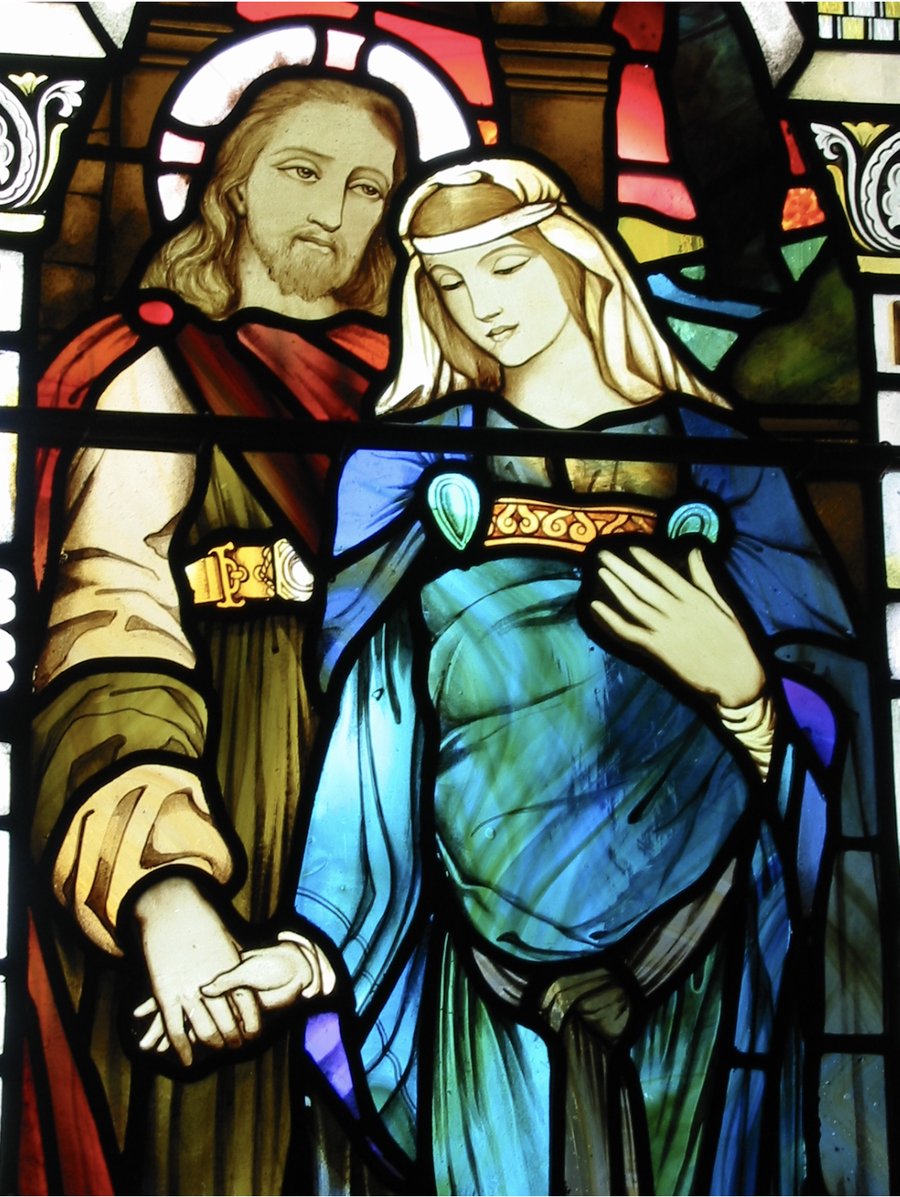
My work reclaiming Mary Magdalene as Bride of the Christ is not about the ordinary coupling of a woman and a man. It is about reuniting Sophia and Logos, often called the primary emanations of the unseen Source, gender specific personifications of right and left-brain modalities, and incarnations of feminine/lunar with masculine/solar principles – the Divine Complements. In losing the voice of the Bride – the incarnation of Sophia or the feminine face of God – we also lost the color red, our passion for life. We lost our connection with flesh and blood, with our own body’s innate wisdom, and with the rest of the created cosmos. Sadly, we lost the “way of the heart,” the Eros-relatedness of all that lives, and our direct experience or gnosis of the Divine.
In reclaiming Mary Magdalene as Bride and Beloved, we restore the ancient balance inherent in Sophia and Logos, the archetypal Bride and Bridegroom at the heart of early Christian teachings. Ultimately their union presents us an image of the Sacred Marriage between the Human and the Divine, the marriage of flesh and soul that occurs in each of us, for if the truth be told, we are each an earthen vessel, filled with consciousness – the Spirit indwelling. Seen this way, the marriage of the Beloveds is an image of the enlightened self, an image of wholeness and divine potential of the perfected human being.
In the beginning was not only the Logos, but also the Sophia. Together they were in the beginning with God and without Them was made nothing that has been made. In Them was life, and the life was the light of men. Paraphrase of John 1-4
Jesus came to restore and embrace Sophia, so long denigrated under Greco-Roman hegemony over Israel. I believe that his sacred partnership with Mary was at the very heart of the early Christian community, the cornerstone principle later rejected by the architects of the institutionalized Roman Catholic Church. It is time for Christians and all people of faith to reclaim this Sophian heritage, to become once again lovers of Holy Wisdom, and to celebrate the sacred union of the masculine and feminine energies of the Divine.
© 2007 Margaret L. Starbird. All rights reserved.
Back to Articles