As Christians around the world prepare to celebrate the birth of their Savior on the twenty-fifth day of December, we pause to examine the Gospel narratives of the canonical New Testament and the powerful mythology embodied in Jesus Christ, the “ICHTHYS.” This title, the “Fish,” was derived from the initial letters of the words found in the Greek phrase “Jesus Christ, Son of God, Savior” (ΙΧϑΥΣ) and was one of the early titles Christianity’s founders used to describe Jesus. Today, we find the fish symbol attached to bumpers on cars owned by Christians, and the logo identifying Jesus and Christianity with the fish is repeated throughout our culture. We are taught that the twelve apostles of Jesus were called to be “fishers of men” and in various passages of the Gospels we encounter references to fishing and fishermen. The early Church adopted the metaphor of the church as the net filled with fishes, the converts to the “Way.” Its Baptismal fonts were called “little fish-ponds” (piscina) and the members of the community were the “little fishes,” the pisciculi. In John 21 the disciples out in the boat who have failed to catch any fish are told to cast their nets over the starboard side, where they harvest a surprising catch of 153 fishes. Apparently there was something very special about fish in the eyes of the earliest Christians that encouraged the authors of their sacred texts to make these numerous associations.
Matthew’s Gospel, written about A.D. 80-85, mentions that Magi came from the East to Jerusalem, saying “Where is he that was born king of the Jews, for we have seen his star” (Matt 2:2). These Magi were Persian priest/astrologers who were well aware of the precession of the equinoxes and were eagerly awaiting the birth of the “Kyrios” or “Bearer” of the Light for the dawning New Age of Pisces. They were actively seeking the “Lord of the Fishes” and scanning the heavens for any sign of his approach. This person would be the great teacher or “Magister”—the avatar for the coming age of Pisces whose constellation was rising precisely at that time. A triple conjunction of Jupiter and Saturn in Pisces that occurred in the year 7 B.C. announced the birth of the long awaited Jewish Messiah to astrologers eagerly searching the skies for any spectacular sign of his birth.1 It was to this “Lord/Kyrios,” the infant Jesus, that the Magi traveled from afar to do homage, “and falling down, they worshipped him, and opening their treasures, they offered him gifts of gold, frankincense and myrrh” (Matt 2:11), gifts symbolic of his royal, priestly and sacrificial roles.
This Gospel verse suggests the height of esteem in which Jesus was held by the author and by his community of believers. So special was Jesus that the planets and stars themselves heralded his birth and foreign dignitaries knelt before him. Jesus was associated from the very beginning with the dawning the Age of Pisces. Authorities in the 4th century designated the birth date of Jesus as the middle of the night between the 24th and 25th of December, which was the final month of the Julian calendar. This date occurs very near to the winter solstice, the point at which the sun reaches its lowest point in the northern hemisphere, and was appropriate on the basis that Jesus was a bringer of “new light”—heralding the return of the sun in its yearly cycle. It was also the date on which the birth of Mithras, the Persian god-hero, was celebrated in a widespread cult associated with the slaying of the bull. This “astrological” religion, very popular in the Roman Empire, honored the supplanting of Taurus (the Bull) by Aries (the Ram), the zodiac signs of the two ages that immediately preceded Pisces. It should comes as no surprise, then, that the religion of the “Fishes” eventually supplanted Mithraism in the Roman Empire; according to the demonstrable precession of the constellations, its time had come. Ancient philosophers and astrologers apparently identified Saturn with the Jews and Jupiter with kingship, so their triple conjunction in Pisces clearly heralded the birth of the prophesied Jewish Messiah.
Scholars scanned the ancient texts for prophecies concerning the advent of the Messiah. He would be an heir of royal Davidic lineage, the “Scepter” from the line of Judah and “Sprout” from the staff of Jesse.” Born in Bethlehem, the City of David, he was the “chosen” and the “anointed,” sent to bring “glad tidings” to the lowly and to heal the brokenhearted, to proclaim liberty to captives…and to comfort all who mourn.” He would come as the representative of Yahweh, the Bridegroom of Israel. And he would bring teachings that would enlighten the entire world for the age to come. Followers of the Christian “Way” later identified Jesus with the Fish. Christian bishops wear a fish-shaped mitre and Roman Catholics are encouraged to eat fish on Friday, which was originally the day of Venus, the love-goddess associated with the ancient symbol called the “Vesica Piscis”— the “vessel of the fish.”
is the shared space
formed when two circles intersect
Having now examined some references to the Fish and the fishes that recur in Christian lore, we are faced with an increasingly curious anomaly. The constellation of Pisces is not represented with one fish, but two fish swimming together but facing in opposite directions, rather like a “yin/yang” symbol, the ancient representation of the equal opposite energies sometimes characterized as “masculine” and “feminine.” Apparently this sign of the “Fishes” was to have represented a similar balance and symmetry, an egalitarian principle of harmonious co-existence and symbiosis. And, in fact, the earliest Christian community seems to have had teachings that correctly reflected the nature of this symbol for wholeness and balance, the “All” and “Cosmic Wholeness.”
An examination of the New Testament Gospels confirms this thesis. Throughout the Gospels we find stories and parables about women: one widow gives an offering from her want, another sweeps her house searching for a lost coin, an adulteress is rescued from stoning, a woman declared “unclean” is healed of the flux, the daughter of Jairus is raised from the dead. Mary, the sister of Lazarus, sits at the feet of Jesus drinking from the words of his mouth, while Martha is worried about preparations for dinner, and it is a group of faithful women who stand near the cross mourning the crucifixion while the Apostles cower in hiding, and another who go to the tomb on Easter morning. These narratives are remarkable for their time, a time when women were treated like chattel, denied the right to bear witness in court cases, and divorced with awesome ease on frivolous grounds. In fact, it appears that the earliest Christian community, relying on the teachings of Jesus, was essentially egalitarian and honored women in a way unprecedented in their time and milieu. In his epistles, Paul mentions various women including Phoebe, a deaconess, Prisca, and Junia, who exercised leadership in early Christian communities. In the Epistle to the Romans (16:6, 12), Paul commends several women—Mary, Persis, Tryphosa, and Tryphaena—for their hard work. In another passage he mentions that the brothers of Jesus and the other apostles travel around with their “sister-wives” (1 Cor 9:5). From this inadvertent statement it is apparent that the earliest Christian missionaries were traveling as couples, not necessarily as pairs of men as we have often been encouraged to believe.
After years of prayer and research, I have come to the conclusion that the model for these “missionary couples” is to be found, not in Paul, who apparently traveled often with a male companion, but in Jesus himself. When Paul teaches that it is not necessary to marry because the coming of the “kingdom” is imminent (1 Cor. 7), he does not use Jesus as his example for celibacy. He says, “even as I.” There is no statement anywhere in the New Testament that Jesus was celibate, and in Judaism, the norm was marriage.
My personal conviction that Jesus was married and that he and his wife modeled the hieros gamos (Sacred Union) as the “archetypal Bridegroom and Bride” rests on twin pillars of my research. The first of these pillars is the Passion narrative, beginning with the anointing of Jesus by a woman, followed by the torture, death and resurrection which is found closely paralleled in numerous ancient mythologies and liturgies of pagan “bridegroom/gods” similarly sacrificed and resurrected. And the second pillar is the gematria (number codes) of the New Testament that confirms the preeminent status of Mary Magdalene as the Bride and Beloved of Jesus, status awarded her in later Gnostic texts but denied by the fathers of orthodox Christianity.
Let us now examine the evidence for the “Sacred Marriage” (hieros gamos union) found at the heart of the Christian mythology embodied in the Christ-Couple—“Lord and Lady of the Fishes.
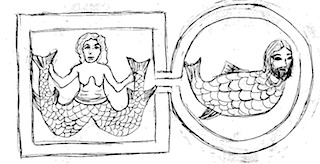
with the mermaid, a frequent symbol for
Mary Magdalene in European art and literature
As Jesus was reclining at the banquet table, a woman carrying an alabaster jar of precious ointment approached him. She broke the jar open and anointed Jesus with its contents, unguent of nard. Then as her tears fell on his feet, she dried them with her hair. This story was so poignant that it managed to survive for a generation in oral traditions concerned with the ministry of Christ and is one of only four stories considered so important that they were included in all four of the canonical Gospels.
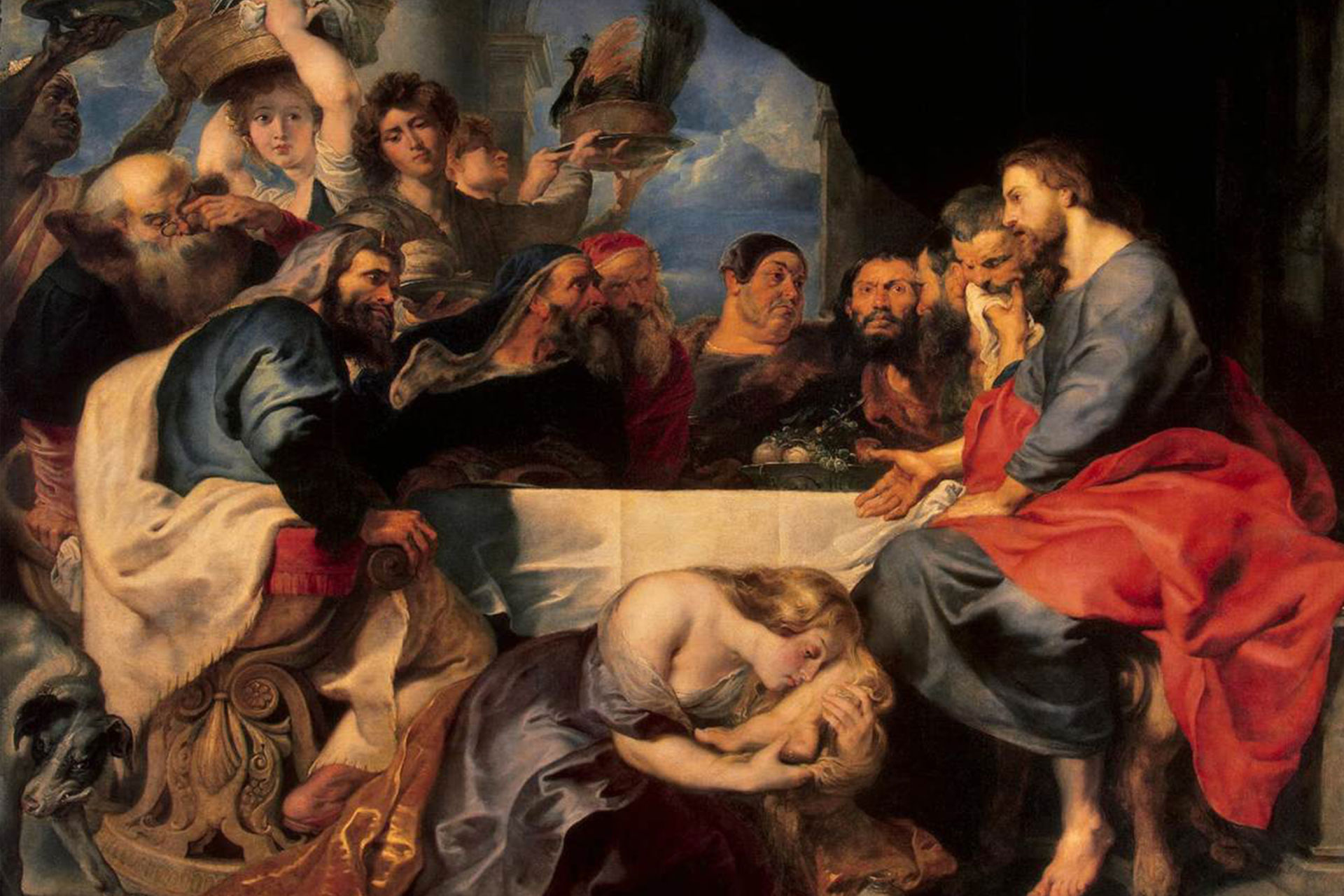
Peter Paul Ruebens
What was it about the story of this anointing by a woman that was so unforgettable? Jesus himself said that wherever this story of the anointing was told, it would be told “in memory of her.” And yet, many people do not even remember her name!
Over the years, the unnamed woman became identified with Mary Magdalene and called a prostitute, an derogatory slander for which there is no foundation in the Gospel, except for an association of the act of anointing with an ancient rite of marriage in which the anointing of the sacred King once the prerogative of his bride, was later performed by a hierodule or “sacred prostitute” In earliest times, the anointing was a nuptial rite derived from the ancient liturgies of the fertility cult of the “Sacrificed Bridegroom.” In the liturgical sequence the Bride and Bridegroom were typically united in marriage amid widespread rejoicing and revelry, following which the Bridegroom was later tortured, mutilated, killed, and entombed. Then, usually after a liturgical pause of three days, the Bride returned to the tomb and found her Beloved resurrected in the garden. Similar rites were celebrated throughout the Near East in the cults of Tammuz/Ishtar, Osiris/Isis, Baal/Astarte, and Adonis/Venus.
Scholars have long noted similarities between the ancient liturgical poetry of the “Sacred Marriage” and the Song of Songs. A poem celebrating the union of Isis and Osiris is in some places verbatim with lines from the Song of Songs, where the fragrance of the Bride’s nard wafts around the Bridegroom at his banquet table, while in the Gospels, the fragrance of the unguent of nard “fills the house.” The connection of the passages is obvious. John’s Gospel very clearly combines elements from the earlier Gospels of Mark, Matthew and Luke in order to establish that there was only ONE anointing of Jesus and that it was performed by a woman with whom everyone in the community was familiar—Mary, the quiet sister of Lazarus.
The entire Hellenized Roman Empire was conversant with this liturgical sequence that is so obviously repeated in the Gospel stories of the anointing, crucifixion, and death of Jesus. The word Christos means, literally, “the anointed one.” And the story of the anointing of Jesus strongly suggests that it was done in accordance with the traditional rites of the hieros gamos—the “Sacred Marriage.” In John’s Gospel, in two places (11:2 and 12:3) we read that the woman who anointed Jesus was the sister of Lazarus, and it is this same Mary who was conflated with the woman called “the Magdalene” in the early Church. Hippolytus of Rome in his commentary on the Song of Songs (early 3rd century) says that it was Mary-Martha who sought the Bridegroom and found him resurrected in the garden—although none of the four Gospels ever mentions Martha at the tomb, while , in each Gospel, Mary Magdalene either alone or with other women, is present at the tomb in the dawn of Easter morning. Clearly it was THIS Mary—the Magdalene--who performed the final stage of the ancient ritual, returning with her women companions to the tomb to mourn the death of the “Sacrificed Bridegroom” and rejoicing to find him resurrected.
The second important pillar of my research is the gematria of the New Testament that confirms that the Mary called the Magdalene was the archetypal Bride of the “Sacred Union.” Gematria refers to a literary device common in Hebrew texts, but also in the Greek passages of the New Testament, that encodes numerical values into key names, titles, and phrases that reflect the values on the sacred “canon of number” familiar in the practice of sacred geometry.2 The sums enhanced the value of the text, like setting a song to music. The Scripture passages were set to number. The sacred number associated with “the Magdalene” is 153—the number of the fishes in the net mentioned in the Gospel of John, a metaphor for the Church—the “Bride” whom Christ loved so much, he gave his life for her. While Christ carries the archetype of the Divine as “Bridegroom,” of his people, in the ancient tradition of Yahweh and his covenant with Israel, Mary Magdalene carries the archetype of the community, the “Daughter of Zion,” as “Bride.” The Magdalene is mentioned first on seven of eight lists of women who walked with Jesus. Matthew 28 says that Mary Magdalene and the “other Mary” went to the tomb. It was clearly she, rather than the “other Mary,” who was First Lady in the eyes of the early Christian community. Her title, I believe, was derived from the prophecy of Micah concerning the “Magdal-eder,” a metaphor for the Daughter of Zion , Jerusalem herself! “Why do you weep? Has your counselor perished? Have you no King?” (Micah 4:8-10). This poignant prophecy mentions her exile and eventual return, elements that fit precisely with the legends of Mary Magdalene that record her political exile in Gaul, where she is said to have sought refuge with her brother, sister and friends in the year 42, bringing with her the “Holy Grail.” It is this legend that is at the root of the currently controversial “heresy” of the Holy Grail, the sang raal or ‘blood royal.” One does not carry the “blood royal” in a jar. It flows in the veins of a child. Did a child of the union of Jesus and Mary Magdalene survive as a refugee in Gaul? If so, the child was a daughter, for the legend asserts that a pre-adolescent child accompanied the party of refugees from Judea, and that her name was Sarah, which in their native Hebrew, means “princess.”
These and related arguments establishing the “Sacred Union” at the heart of Christianity are developed in my books, particularly The Woman with the Alabaster Jar and Magdalene’s Lost Legacy. The forgotten mythology of the archetypal Bride and Bridegroom is fundamental to our planet, where the model for biological life is “sacred union” of masculine and feminine partners. In early passages from Genesis we read: “It is not good for the man to be alone. I will make a partner for him.” That was God speaking! What we see unraveling in the Roman Catholic Church is the false paradigm of the “wounded Fisher-King” whose painful thigh wound that cannot heal is a sexual disfunction—because he has no partner. The land becomes a wasteland and can only be healed when the feminine partner is restored to the “Fisher King”—the essence of legends of the Holy Grail. The tragic flaw in Christian doctrine is the loss of the Sacred Feminine, the Beloved—as intimate partner.
In the ancient world, the number 153—the value of “h Magdalhnh”—was identified with the shape widely known to Greek mathematicians as the “measure of the Fish,” identified with the () –the Vesica Piscis. Christ was the called “Ichthys” and Magdalene was the “Vessel of the Fish” in the symbolic language of the early Church. How can we doubt that they were deliberately styled as partners? The evidence is found in the Gospels themselves and is confirmed in a later codex found among the Gnostic texts at Nag Hammadi, the Gospel of Philip which states that Mary Magdalene was the “companion” of Jesus—his koinonōs—which should be translated “consort” rather than “good friend” or “apostle.” Irenaeus accused the Gnostics of using “numbers theology” for their interpretation of Scripture and chastised them for this practice. But it is precisely in the numbers that the pre-eminence and true role of Mary Magdalene emerge. She was partner and Beloved, the model for the Church and for each human soul as Sacred Bride of the “eternal Bridegroom”—the Christ.
The “new light” dawning in the first century and embodied in Jesus Christ and his Beloved was reflected in the constellation Pisces, the TWO FISHES. The inherent partnership paradigm of the constellation, modeled for the earliest Christians, was tragically broken in the cradle, although the egalitarian teachings of Jesus survived in the Gospel narratives along with vestiges of the “sacred union” mythology and the gematria that confirms it. These are the nascent teachings of Christianity that need to be reclaimed at this crucial period in the history of humankind. The doctrines derived from the “Sacred Union” are life-giving, egalitarian, and inclusive, deeply respectful of life in all its diverse forms, of the planet Earth and all her children. These doctrines are summed up in the ancient mandala of the hexagram which represents the “Cosmic Dance” of the opposite energies, the “Shiva/Shakti” of ancient Indian mythology—the Star of David which is formed from the union of triangles representing Fire (masculine) and Water (feminine).3 “Where is he who is born king of the Jews, for we have seen his star”—the Star of Bethlehem, the Star of Sacred Partnership.
Footnotes:
1. David Fideler, Jesus Christ, Sun of God. (Wheaton IL: Quest Books, 1993) p 169.
2. See Margaret Starbird, Magdalene’s Lost Legacy (Rochester, VT: Inner Traditions International, Bear and Company, 2003) for further details about the gematria of Mary Magdalene and the “Fishes.”
3. Margaret Starbird, The Woman with the Alabaster Jar (Sante Fe, NM: Bear and Company, 1883) 166-167.
© 2009 Margaret L. Starbird. All rights reserved.
Back to Articles